Your ClinicalTrials.gov download is not the data. It is the start of a six-week cleanup.
Pharma and biotech data engineers hear this request constantly: a research or competitive intelligence team needs a view of trial activity, and ClinicalTrials.gov looks like the obvious source. It is public, it is comprehensive, and it updates daily. It also arrives in a shape that no analyst can use.
What Raw ClinicalTrials.gov Data Actually Looks Like
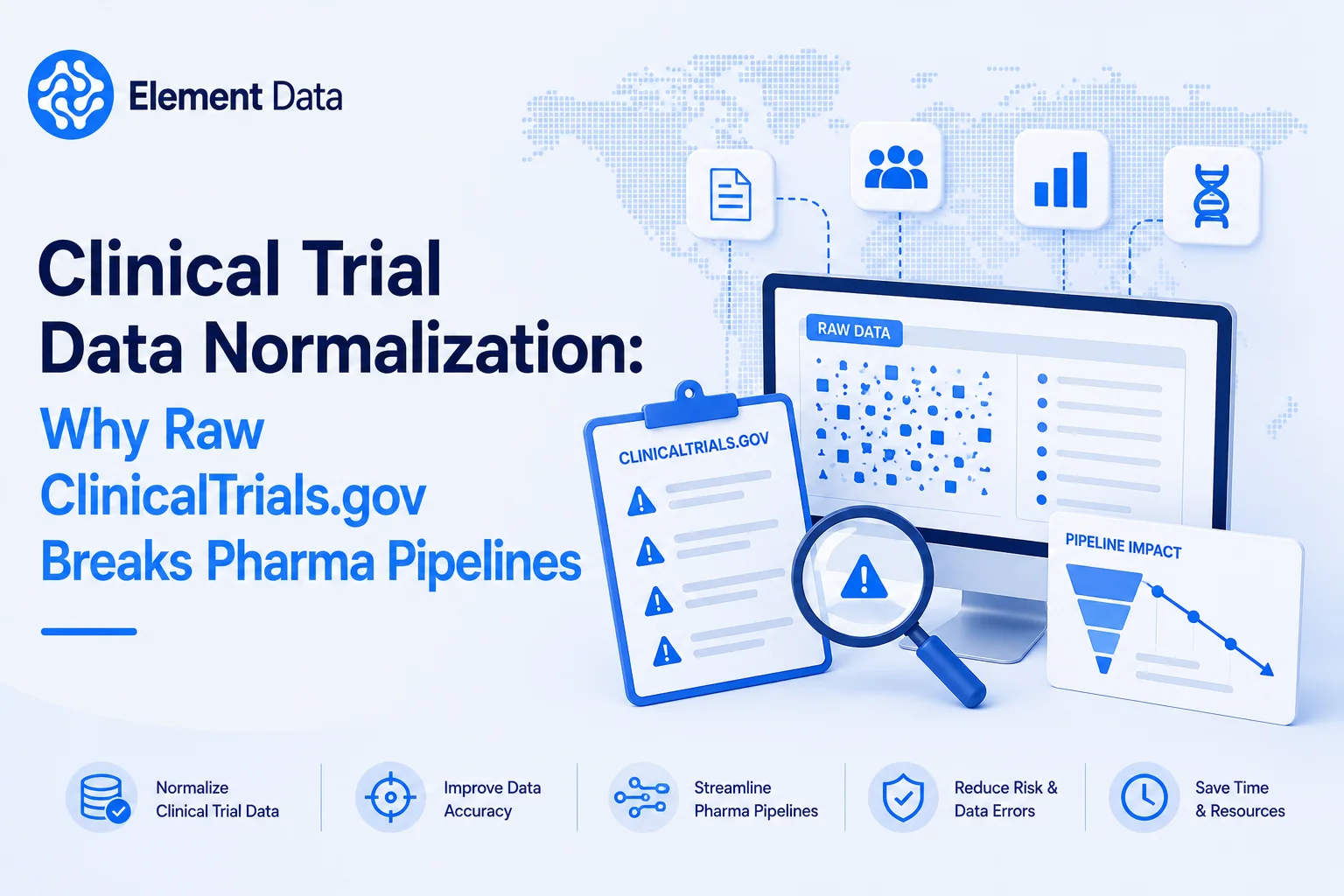
Pull a raw export and the problems surface immediately. Sponsor names are inconsistent: the same company appears under a full legal name, an acronym, a subsidiary, and at least one misspelled variant. Trial status fields need interpretation before they mean anything. Dates are missing in places where a downstream query assumes they exist. Fields shift structure across records depending on when a trial was registered.
None of this is a data quality failure on ClinicalTrials.gov’s part. It is a public registry, not a production data product. The gap between “publicly available” and “usable in an enterprise pipeline” is exactly where pharma data teams lose weeks.
Where the Cost Actually Lands
The request for trial data usually comes from competitive intelligence or a BD team with a deadline. The work lands on data engineering. Before anyone can benchmark a competitor’s pipeline or map trial activity by therapeutic area, someone has to normalize sponsor names, standardize status codes, backfill or flag missing dates, and document a schema stable enough to build on.
That is a multi-week project before the first real query runs. It repeats every time a team needs a fresh pull, unless someone commits to maintaining the normalization logic indefinitely, including whenever ClinicalTrials.gov changes its export format.
What Normalized, Snowflake-Native Data Removes
Element Data’s AACT dataset delivers ClinicalTrials.gov data already normalized and structured, landing directly in Snowflake. Sponsor names are standardized. Trial status and phase fields are consistent. The schema is stable across the full trial history, not just newly registered trials.
For a pharma or biotech data engineer, the practical difference is where the first sprint goes. Instead of spending it on cleanup, the team spends it answering the question research or BD actually asked: which competitors are active in a given indication, how deep is a target’s pipeline, where is trial activity accelerating or slowing.
Public data is only useful once it is production-ready. That is the entire premise behind normalized AACT data in Snowflake, and it is why pharma teams increasingly treat “normalize it ourselves” as the expensive option rather than the default one.