




Corporate filings and structured financial statement data, delivered as query-ready Snowflake tables – so fundamental and quant teams can analyse with SQL instead of scraping EDGAR and parsing XBRL.
SEC EDGAR is the SEC’s public system of company filings – 10-Ks, 10-Qs, 8-Ks and more – including structured XBRL financial data. Element Data delivers it in Snowflake as query-ready tables, with company-specific XBRL tags normalised to standard US-GAAP concepts where a defensible mapping exists.
EDGAR – Electronic Data Gathering, Analysis, and Retrieval – is the U.S. Securities and Exchange Commission’s public database of corporate filings by U.S.-listed companies. It includes annual reports (10-K), quarterly reports (10-Q), current reports (8-K), foreign-issuer forms (20-F, 40-F, 6-K), registration statements (S-1), and more.
Since 2009, financial statements are also filed in XBRL – a structured, machine-readable format – which the SEC exposes through data APIs and bulk archives. XBRL is what makes cross-company financial analysis possible without a team of people reading PDFs.
Source: U.S. SEC, EDGAR · EDGAR APIs · Financial Statement Data Sets
Filing metadata – company submission history by CIK, form type, and date.
XBRL financials – standardised income statement, balance sheet and cash-flow facts under US-GAAP.
Full text – the filing documents themselves, for text and disclosure analysis.
Working with EDGAR directly means respecting request rate limits, parsing XBRL taxonomies, reconciling company-specific tags to standard concepts, and stitching multi-period data – all before any analysis begins.
Handle with care. GDELT measures coverage, not reality. Reporting density differs sharply by country
and language, automated coding makes mistakes, and a single event syndicated widely can look like
many events. Serious signal work normalises against baseline coverage volume and validates against a
second source. We would rather you knew that before you subscribed.

Fundamental and quant research - screen and model on standardised financials across the full universe.
Financial modelling - pull income statement, balance sheet and cash-flow facts by company and period.

Event studies - pair filing events, particularly 8-Ks, with market and news data.
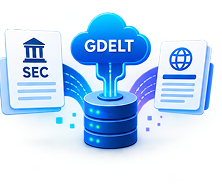
Alt-data pairing - combine SEC fundamentals with GDELT news signals for richer models.
Disclosure and text analysis - run language analysis across thousands of filings rather than a hand-picked sample.

One caveat on standardisation. Cross-company comparability in XBRL is good, not perfect. Issuers extend the taxonomy, restate periods, and occasionally tag inconsistently. Where we cannot map a custom tag to a US-GAAP concept defensibly, we preserve the original rather than force a match – which means some cells are null by design. We would rather hand you a visible gap than an invisible wrong number.
Data provenance. SEC filings are public records published by the U.S. SEC. Element Data is an
independent Snowflake data provider, not affiliated with the SEC.
Core filings include 10-K, 10-Q, 8-K, 20-F, 40-F, 6-K, and S-1, plus the structured XBRL financial data companies file alongside them. Form coverage is documented in the schema notes we share with the dataset.
XBRL is a machine-readable format for financial statements, required by the SEC since 2009. It lets you extract standardised income statement, balance sheet, and cash-flow facts across companies rather than reading each filing individually. The SEC publishes it through the EDGAR APIs and as financial statement data sets.
Yes. EDGAR is public and free, and if your team is happy respecting the SEC’s request rate limits and parsing XBRL taxonomies, you can absolutely do this yourself. Element Data’s value is delivery – filings and financials structured and query-ready in Snowflake, joinable to your other data.
This is the genuinely hard part of working with XBRL. Companies extend the standard taxonomy with custom tags, so a naive extract produces columns that do not line up across issuers. We normalise to standard US-GAAP concepts where a defensible mapping exists and preserve the original tag where it does not, so you can see what was mapped and make your own call.
Yes – the filing documents themselves are included, so text and disclosure analysis runs in SQL against the same tables as the financials. For interactive one-off lookups, the SEC’s own full-text search is often quicker; the Snowflake dataset is for when you need to run the search across thousands of filings programmatically.
That is one of the most common patterns we see. Joining SEC fundamentals to GDELT news flow around the same entities lets you pair a disclosure event with the coverage surrounding it. Both datasets sit in the same account, so the join is ordinary SQL.
Element Data is built by Liquid Technologies (Liqteq). We deploy frontier AI inside healthcare and regulated organisations’ own environments, cloud or on-premises, so they get frontier capability without their data ever leaving their control. When a project needs pipelines or models built around that data, the same team does it, inside the same boundary.
AI solutions provider and data engineering, delivered inside your environment.
AI-powered payer contract intelligence for IPAs, MSOs, and provider networks.
Video intelligence turning camera feeds into real-time operational alerts.
The AI operations layer for teams, deployed inside your own cloud.
Set up a free consultation with our data experts and see how quickly you can access — and monetize — the data that moves your business.
Tell us about your data requirements, and our team will Shortly Connect with you