
ClinicalTrials.gov is free. Getting it into production costs six weeks of engineering time.
That math does not show up in any procurement document. But every pharma data engineer who has tried to normalize raw clinical trial exports knows exactly what it costs.
Sponsor names are inconsistent. Roche appears as “Hoffmann-La Roche”, “F. Hoffmann-La Roche”, and “Roche” in the same dataset. Trial statuses require interpretation. Date fields are missing or formatted differently across records. The schema shifts depending on when the trial was registered.
The competitive intelligence team asked for a pipeline benchmarking report. The data engineering team inherited a normalization project.
Why Raw ClinicalTrials.gov Data Breaks Production Workflows
Public clinical trial data is not production data. It is a government registry optimized for regulatory compliance, not enterprise analysis.
When a pharma data team downloads the raw export, they get over 400,000 trial records with inconsistent formatting across nearly every field that matters for analysis.
Sponsor normalization alone can take weeks. A single company may appear under dozens of name variations. Without normalizing those names, competitor pipeline analysis is impossible. You cannot count Pfizer’s oncology trials if Pfizer appears as fifteen different strings in the sponsor field.
Trial phase data requires interpretation. Phase 1/2 trials exist. So do “Phase 1” and “Phase I” and “Early Phase 1”. Rolling those up into a consistent taxonomy is manual work.
Intervention types, therapeutic areas, and enrollment numbers all carry similar inconsistencies. Each one requires a normalization decision before the data is usable.
The result: a data engineer who expected to spend a few days on ingestion spends six weeks building a normalization layer that still needs maintenance every time the source updates.
AACT Clinical Trial Data on Snowflake: Already Normalized
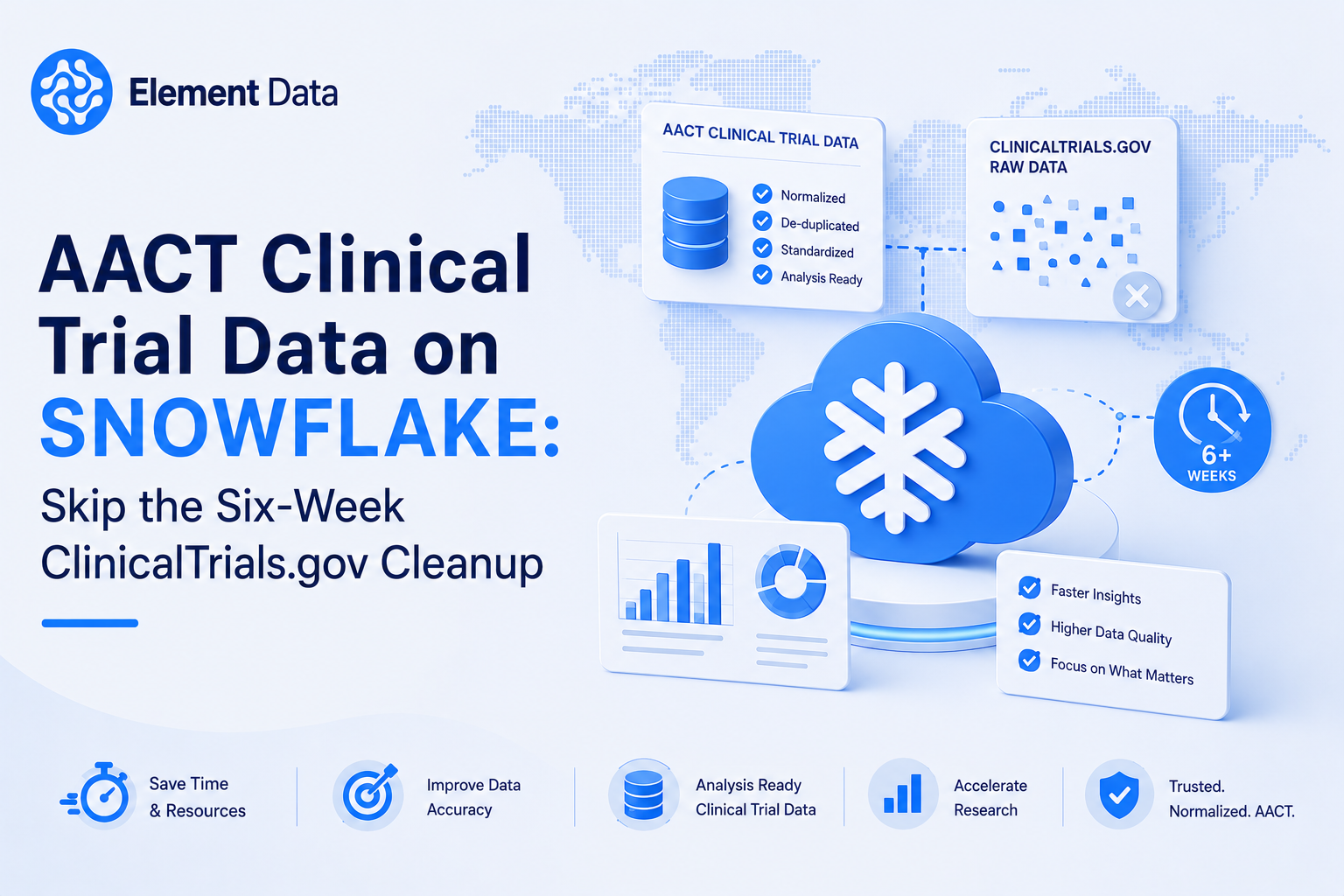
Element Data’s AACT dataset is the normalized version of ClinicalTrials.gov, delivered directly inside Snowflake.
Sponsor names are standardized. Trial phases are taxonomized. Dates are parsed and validated. The schema is consistent and documented.
When a pharma data team accesses AACT through Snowflake Marketplace, they skip the entire normalization sprint. The data lands ready to join against internal tables, ready to query for competitive intelligence, ready to support the BD team’s pipeline benchmarking request.
No ingestion pipeline to build. No schema to reverse-engineer. No ongoing maintenance when ClinicalTrials.gov changes its export format.
Explore the full AACT schema and table reference to see how the tables, columns, and relationships map out before you query.
What Pharma Teams Use AACT Data For
The use cases are specific and commercial:
- Competitor pipeline benchmarking. How many Phase 3 oncology trials does a competitor have active? What indications are they targeting? Where are they enrolling patients?
- Therapeutic area intelligence. Which therapeutic areas are seeing increased trial activity? Where is investment flowing?
- BD and licensing research. Before an acquisition or partnership decision, teams need to understand a company’s clinical development portfolio. AACT data supports that diligence.
- Trial design analysis. What endpoints are competitors using? What enrollment sizes? How are trials structured across phases?
These questions require normalized data. Raw ClinicalTrials.gov exports cannot answer them reliably until someone fixes the sponsor names, standardizes the phases, and validates the dates.
The Snowflake Advantage for Clinical Data
AACT data delivered through Snowflake Marketplace is not the same as a data vendor emailing a CSV.
The data lives inside your Snowflake environment. No file transfer. No staging tables. No ETL pipeline between the vendor and your analysis layer.
When Element Data refreshes the AACT dataset, your environment gets the update automatically. No manual re-ingestion. No schema drift to debug.
For data engineering teams already running on Snowflake, this is the difference between a dataset that creates work and a dataset that eliminates it.
Who Uses Element Data’s AACT Dataset
Data engineers and solution architects at pharma companies including Roche, Amgen, AstraZeneca, and Sumitovant Biopharma have requested access to the AACT dataset.
Healthcare consultancies including ZS and Deloitte use it for client engagements involving clinical trial benchmarking and pipeline analysis.
Snowflake sales engineers pull it to demo realistic healthcare data to life sciences prospects.
The common thread: these are teams with real analysis to run and no interest in spending six weeks normalizing a public dataset before they can start.
The Real Cost Calculation
A senior data engineer costs a pharma company roughly $80 per hour fully loaded. Six weeks of normalization work is 240 hours. That is $19,200 in engineering time before anyone runs a single query.
That cost recurs every time ClinicalTrials.gov changes its export format. It recurs every time a new team member needs to understand the homegrown normalization logic. It recurs every time a stakeholder asks why the pipeline benchmarking numbers do not match last quarter’s report.
Normalized AACT data on Snowflake is not a convenience. It is a budget decision that shows up in recovered engineering capacity and faster time to analysis.
Frequently Asked Questions
How do I access clean clinical trial data in Snowflake?
Request access to Element Data’s AACT dataset through Snowflake Marketplace. The data is normalized, documented, and available inside your Snowflake environment with no ingestion pipeline required. Once approved, you can query it directly against your internal tables.
What is the difference between raw ClinicalTrials.gov data and AACT?
Raw ClinicalTrials.gov exports contain inconsistent sponsor names, unstandardized trial phases, missing dates, and shifting schemas. AACT is the normalized version: sponsor names are standardized, phases are taxonomized, dates are validated, and the schema is consistent across all records.
How often is the AACT dataset updated?
Element Data refreshes the AACT dataset regularly to reflect new trial registrations and status updates from ClinicalTrials.gov. Because it is delivered through Snowflake Marketplace, updates appear in your environment automatically with no manual re-ingestion.
Can I join AACT data to my internal clinical data in Snowflake?
Yes. The normalized schema is designed for enterprise joins. Pharma data teams use AACT data alongside internal pipeline data, CRM records, and research databases to build competitive intelligence and BD research workflows.
Is AACT data suitable for regulatory submissions?
AACT data is sourced from ClinicalTrials.gov, the official registry. However, regulatory submissions typically require data directly from the source with full audit trails. AACT is best suited for competitive intelligence, pipeline benchmarking, and research workflows rather than regulatory filings.
Request Access to AACT Data on Snowflake Marketplace
Your competitive intelligence team is waiting on pipeline benchmarking analysis. Your BD team needs trial data for a licensing decision. Your data engineers should not spend the next six weeks normalizing a public dataset.
Request access to Element Data’s AACT dataset on Snowflake Marketplace. The data lands normalized, documented, and ready to query.