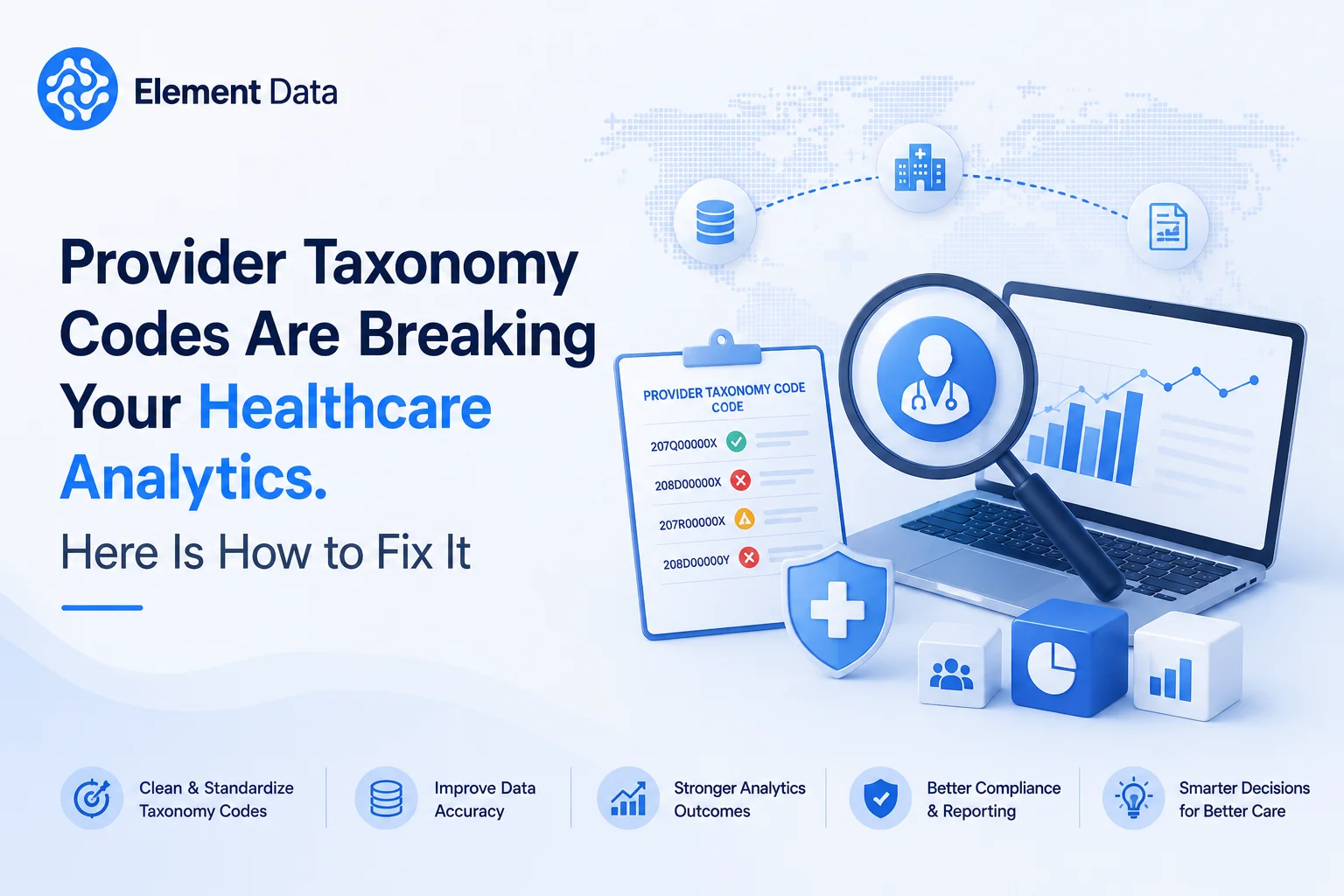

A single misclassified provider taxonomy code can cascade through every downstream analysis your team runs.
Utilization reports show the wrong specialty mix. Referral logic routes patients to providers who do not match. Network adequacy calculations fail compliance checks. Payer analyses skew because the underlying provider classification is wrong.
This is not a theoretical risk. It is happening right now in healthcare data teams across the country.
What Provider Taxonomy Codes Actually Do
Provider taxonomy codes are standardized classifications maintained by the National Uniform Claim Committee. They map healthcare providers to their specialties, subspecialties, and service types.
When a provider registers for an NPI number through NPPES, they select taxonomy codes that describe what they do. A cardiologist picks a different code than a cardiac surgeon. A pediatric oncologist picks a different code than a general pediatrician.
These codes are the backbone of provider classification in healthcare data systems. They determine how providers are grouped, filtered, and analyzed.
Why Taxonomy Codes Go Wrong
The problem is not the taxonomy system itself. The problem is maintenance.
Providers change specialties. They add subspecialties. They retire certain services. The taxonomy codes in NPPES should reflect those changes. Often, they do not.
Some providers registered their NPI years ago and never updated their taxonomy codes. Others selected incorrect codes during initial registration. Still others have legitimate changes that simply have not been reflected in the system.
The result is a gap between what the taxonomy code says and what the provider actually does today.
For healthcare data teams, this gap is invisible until it breaks something.
The Real Cost of Taxonomy Errors
Consider a health plan building a provider directory. They pull NPPES data to populate specialty fields. If the taxonomy codes are stale, the directory shows incorrect specialties. Patients search for a cardiologist and find providers who no longer practice cardiology.
Consider a utilization analytics team measuring specialty distribution across a network. If taxonomy codes are misclassified, the specialty mix is wrong. Leadership makes resource allocation decisions based on flawed data.
Consider a referral management system routing patients to specialists. If the taxonomy code says oncology but the provider now focuses on palliative care, the referral fails. The patient waits longer. The care coordination team chases down the error manually.
These are not edge cases. They are standard failure modes when provider taxonomy codes are not actively maintained.
How Element Data Solves the Taxonomy Problem
Element Data delivers normalized, monthly-refreshed NPPES data directly into Snowflake.
This is not a raw CMS download that your team has to clean and parse. It is production-ready provider data with taxonomy codes that align to current NPPES records.
Every month, the dataset refreshes. Providers who updated their taxonomy codes in NPPES are reflected in the data your team queries. Providers who changed addresses, phone numbers, or organizational affiliations are updated.
Your analytics run against current provider classifications, not stale records from a quarterly download someone forgot to refresh.
What This Looks Like in Practice
A healthcare analytics team joins Element Data’s NPPES dataset to their internal claims data. They filter by taxonomy code to analyze utilization patterns by specialty.
Because the taxonomy codes are current and normalized, the specialty groupings are accurate. The utilization stats reflect real provider behavior. The network adequacy report passes compliance review.
No one spent two weeks reconciling taxonomy code mismatches. No one debugged a referral failure traced to a stale provider record.
Read more: NPPES dataset listing page with schema documentation
Why Snowflake-Native Delivery Matters
The traditional approach to NPPES data is painful. Download a large file from CMS. Parse it. Load it into your data warehouse. Build a refresh pipeline. Maintain that pipeline every time CMS changes their format.
Most teams do this quarterly at best. Some do it annually. Many started the process, got it working once, and never touched it again.
Element Data eliminates that entire workflow.
The NPPES dataset is shared directly into your Snowflake environment. No file transfers. No ingestion pipelines. No schema mapping. It lands in your warehouse ready to query, ready to join to your internal tables.
When the data refreshes monthly, your queries automatically pick up the new records. No manual intervention required.
This is not just convenience. It is the difference between provider data that stays current and provider data that slowly drifts out of sync with reality.
Read more: Blog post on eliminating ETL overhead with Snowflake Marketplace data
Who Uses This Data
Healthcare organizations of every type rely on accurate provider taxonomy data.
Provider networks use it to maintain accurate directories and support credentialing workflows. Health plans use it to validate network adequacy and analyze provider utilization. Patient engagement platforms use it to match patients with the right specialists. Oncology data companies use it to identify and classify cancer care providers.
Element Data’s NPPES dataset serves all of these use cases with the same normalized, current, Snowflake-native data.
Frequently Asked Questions
How do I fix provider taxonomy code errors in healthcare analytics?
The most effective fix is sourcing NPPES data that is normalized and refreshed monthly. Element Data’s NPPES dataset in Snowflake Marketplace provides current taxonomy codes without requiring your team to build and maintain a CMS ingestion pipeline. When the source data is accurate and current, taxonomy errors in downstream analytics resolve automatically.
How often does Element Data refresh NPPES provider data?
Element Data refreshes the NPPES dataset monthly. This cadence ensures provider taxonomy codes, contact information, and organizational affiliations reflect recent changes in the CMS source system. Quarterly or annual refreshes miss too many provider updates to support accurate analytics.
Can I join NPPES data to my internal claims or patient data in Snowflake?
Yes. Element Data’s NPPES dataset is delivered as a Snowflake data share. It lands in your environment with a clean, documented schema designed for joining to internal tables. Most teams join on NPI number to enrich claims, encounters, or patient records with current provider attributes.
What is included in the NPPES taxonomy code fields?
The dataset includes primary and secondary taxonomy codes for each provider, along with the taxonomy switch indicating which code is primary. Taxonomy descriptions are normalized so you can filter and group by specialty without manual code lookups.
How does Snowflake-native NPPES data compare to buying from a traditional data vendor?
Traditional vendors deliver files that require ingestion, parsing, and ongoing pipeline maintenance. Snowflake-native delivery from Element Data eliminates that overhead entirely. The data is queryable immediately with no ETL. Monthly refreshes happen automatically. Your team spends time on analysis, not data engineering.
Get Accurate Provider Taxonomy Data in Snowflake
Provider taxonomy accuracy is not a nice-to-have. It is the foundation every other provider analysis depends on.
Request access to Element Data’s NPPES dataset on the Snowflake Marketplace. Your team can be querying normalized, current provider data this week instead of debugging taxonomy errors for the next quarter.