Provider data matching is not a generic enrichment task. A patient-routing platform, a payer analytics team, and a pharma commercial team may all need provider data, but they do not need it for the same job.
Patient routing depends on current location and specialty data. Payer analytics needs taxonomy, utilization, network context, and a way to compare provider activity over time. Pharma commercial teams need provider identity, practice geography, affiliation context, and reliable matching to internal account data.
That is why evaluating NPPES or other provider datasets by coverage alone creates risk. A dataset can include a large number of provider records and still fail the workflow that matters. The better question is simple: what decision will this provider record support?
Coverage Alone Does Not Solve Provider Data Matching
Coverage is easy to measure. Workflow fit is harder, but it matters more in production. If the data is being used for broad market sizing, a small number of stale or incomplete records may not change the analysis much. If the same records are used for patient routing, territory planning, referral analysis, or provider targeting, the cost of stale data increases quickly.
A stale NPI record can create avoidable operational drag. A provider may have moved locations. A specialty may be outdated or too broad for the decision at hand. A practice address may not match the location where the provider actually sees patients. A record may look complete until it has to join cleanly to internal account, claims, CRM, or network data.
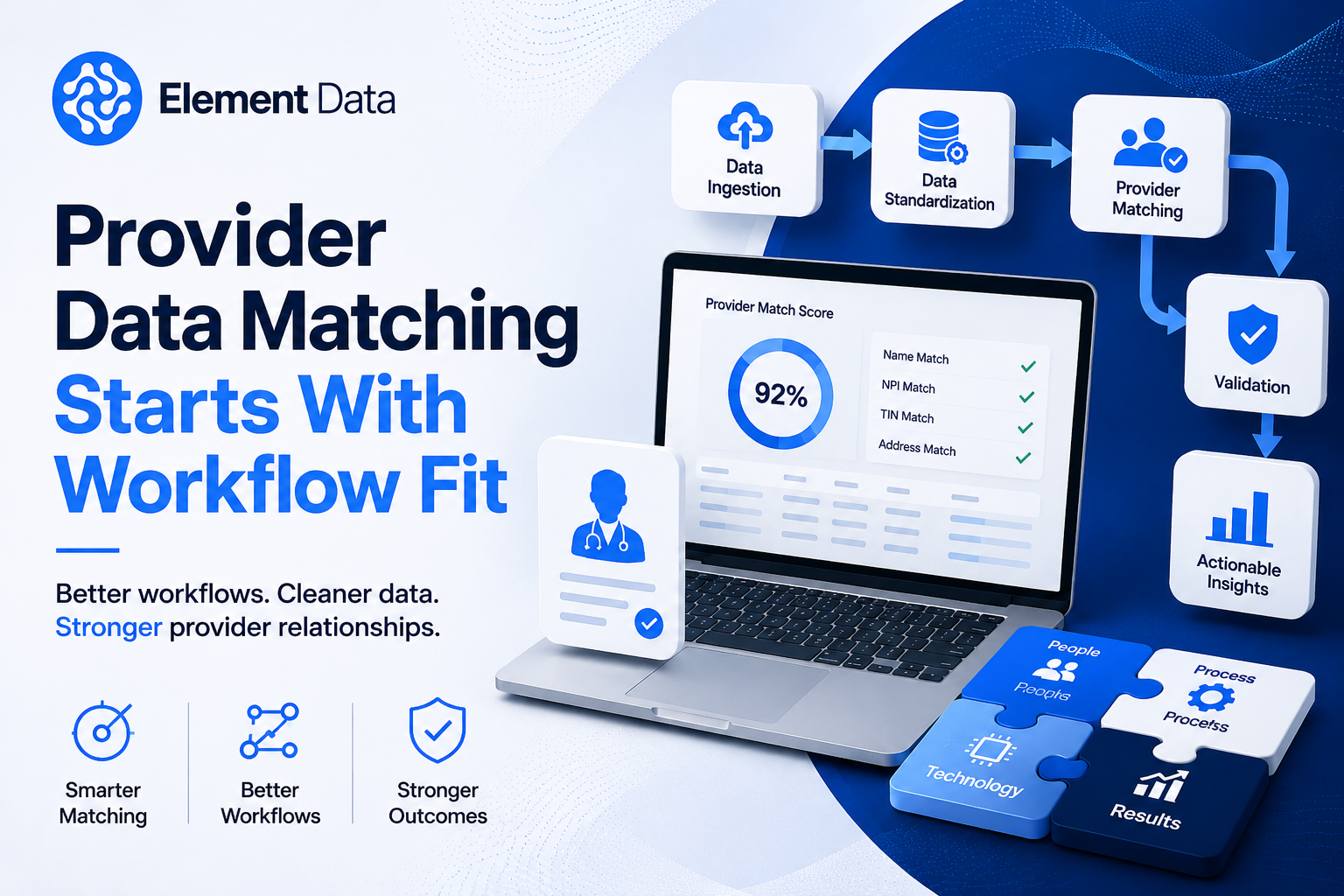
Those problems are not solved by adding more provider records. They are solved by making the provider data usable for the specific workflow. That means looking at freshness, match logic, field structure, joinability, and how exceptions are handled when the record does not fit cleanly.
Provider Data Requirements Change by Workflow
Patient-routing workflows need provider data that is current enough to support real-world operational decisions. Location, specialty, accepting-status signals where available, and facility context can matter more than broad record counts. A provider record that is technically present but operationally stale can send work to the wrong place.
Payer analytics teams often need a different view. They may care about taxonomy, utilization patterns, payment context, provider organization relationships, and network-level analysis. The provider record becomes useful when it can be joined to claims, contract, geography, and network data without creating another manual cleanup layer.
Pharma and life sciences commercial teams need yet another version of provider usefulness. Provider identity has to map to account planning, practice geography, field territories, specialty focus, and internal customer records. In that context, provider data matching is not just enrichment. It is the foundation for segmentation, targeting, and field execution.
The same NPI can sit inside very different workflows. Treating every provider data use case the same leads to weak evaluation. The dataset should be judged by the operating job it has to support.
Why Snowflake-Native NPPES Data Helps
Healthcare teams increasingly want provider data where their analytics and workflow logic already live. Moving files between systems, rebuilding ingestion pipelines, and normalizing public data before every analysis slows down the work before the real evaluation even begins.
Snowflake-native delivery removes much of that friction. Normalized NPPES data in Snowflake gives teams a cleaner starting point for joining provider records to internal systems, CMS data, geography, field plans, network analytics, and downstream workflow logic.
Element Data makes normalized NPPES data available in Snowflake so teams can evaluate provider records inside the environment where decisions already happen. The value is not just access to public provider data. The value is reducing the work required to turn that data into something repeatable, joinable, and useful.
For teams comparing provider data options, the practical test is not whether the dataset exists. It is whether the data can support the workflow without forcing analysts and engineers into constant cleanup.
The Right Provider Data Fits the Operating Job
Provider data matching should start with the decision the workflow has to support. Routing, analytics, targeting, network analysis, and field planning all place different demands on the same underlying provider records.
If the workflow depends on current location data, then freshness and address quality matter. If it depends on specialty analysis, taxonomy and specialty mapping matter. If it depends on internal account matching, stable identifiers and join logic matter. If it depends on repeatable analytics, schema stability and refresh discipline matter.
The goal is not more provider data. The goal is provider data that fits the operating job. When that data is normalized and delivered directly in Snowflake, teams can spend less time rebuilding public data and more time testing whether the workflow works.