
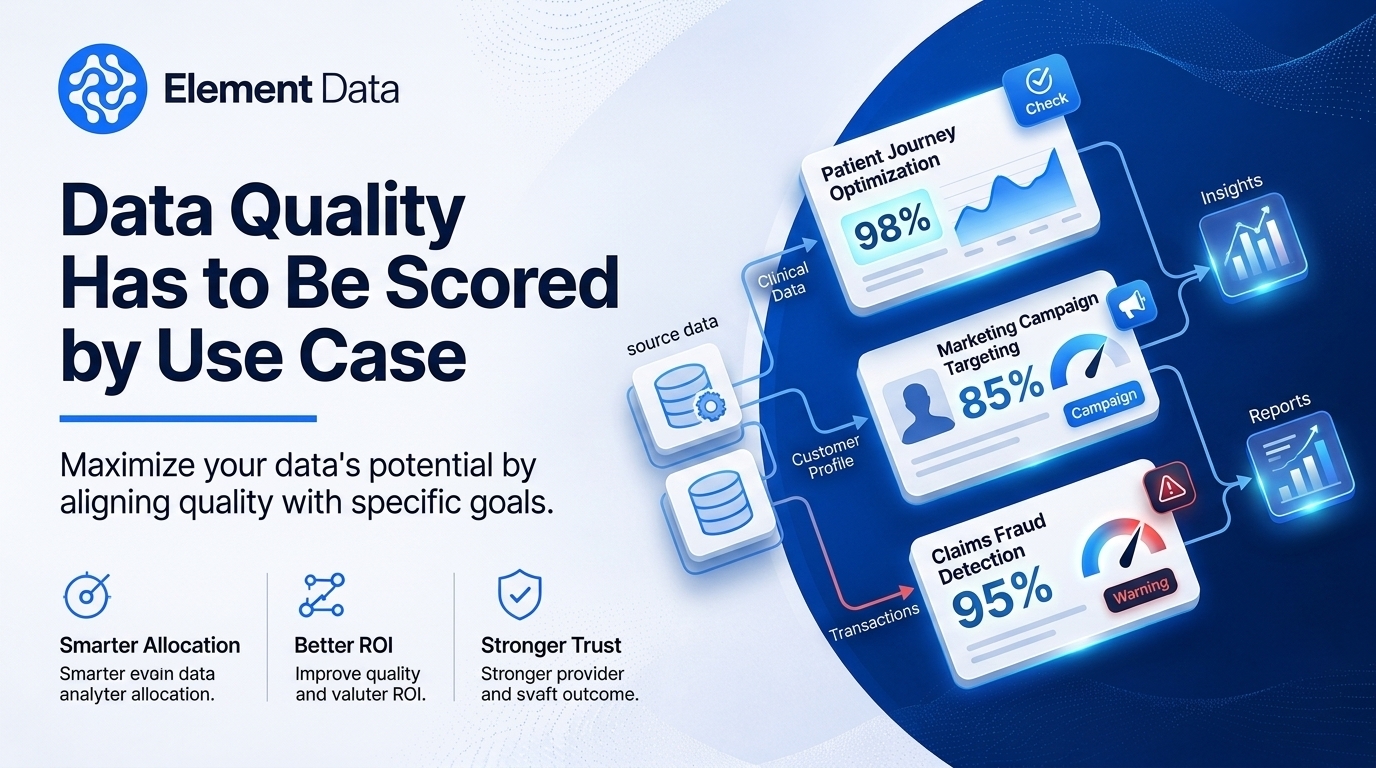
“Is this data good?” is the wrong question for healthcare and life sciences teams. A better question is more specific: good for what workflow?
A provider location field might be good enough for market analysis and unsafe for patient routing. A specialty classification might work for segmentation and fail for network analytics. A clinical trial sponsor field might look clean until competitive intelligence needs sponsor-level benchmarking.
Data quality is not universal. It has to be scored against the decision the dataset supports, the refresh cadence the workflow needs, and the source hierarchy the team trusts when records disagree.
Why Generic Data Quality Scores Fall Short
Many teams evaluate external data with broad quality checks. They look at coverage, completeness, duplicate rates, null values, or whether the file can be loaded into the warehouse. Those checks matter, but they are not enough to decide whether the data can support a real workflow.
Coverage can look strong while the most important field is stale. A provider dataset can include millions of records and still create operational risk if practice locations are outdated. A clinical trial dataset can include the right studies and still be hard to use if sponsor names are fragmented. A CMS file can be valuable and still require careful joins before it supports payer, provider, or market analysis.
The practical test is not whether the dataset looks clean in isolation. The test is whether the data holds up when it is joined, refreshed, compared, and used to make a decision.
Quality Depends on the Workflow
Healthcare data quality changes by use case. A broad market sizing workflow may tolerate some stale or incomplete records. A patient routing workflow cannot treat stale provider location data as a minor issue. A pharma field planning workflow may need provider identity, specialty, practice geography, and internal account matching to work together reliably.
The same pattern applies in life sciences. Clinical trial data can support landscape analysis, competitive intelligence, site strategy, and sponsor benchmarking. Each workflow asks different things of the underlying data. Trial status, sponsor normalization, site location, enrollment fields, and condition mapping do not carry the same weight in every use case.
That is why data quality should be scored against workflow fit. Which fields are required for the decision? Which fields are helpful context? Which records need review before they can flow through? Which source wins when two inputs conflict?
Without that use-case lens, teams risk overvaluing datasets that look complete and undervaluing the structure required to make those datasets operational.
Refresh Cadence and Source Trust Matter
Freshness is another place where generic quality scoring breaks down. More frequent refreshes are not automatically better for every workflow. The right cadence depends on what the workflow is trying to detect or decide.
Provider routing and operational workflows may need more current records than annual market research. Clinical trial monitoring may require predictable updates because status changes, sponsor activity, and site changes can affect the analysis. CMS utilization data may be slower-moving, but the team still needs to understand when the data was updated and how it should be compared over time.
Source trust matters too. Healthcare teams often combine public, internal, and third-party sources. When those sources disagree, the workflow needs rules. If a provider address differs between systems, which source wins? If a specialty classification conflicts with internal knowledge, what gets reviewed? If a sponsor name varies across trial records, where does the normalized decision live?
These are data quality questions. They are also workflow design questions. The strongest teams answer them before the data becomes part of a production process.
Snowflake-Native Data Should Hold Up in the Workflow
For teams already working in Snowflake, external data should be ready to evaluate where joins, models, dashboards, and workflow logic already run. Snowflake-native delivery reduces the work required to move from interest to testing, but delivery alone is not enough.
A raw file placed in Snowflake can still create cleanup work. The value comes when external data is normalized, kept current, structured with stable schemas, and prepared for repeatable use. That is what makes the data easier to test against internal records, geography, claims, provider files, clinical trial intelligence, or downstream operational workflows.
Element Data makes public and semi-public datasets usable for enterprise workflows by normalizing them, keeping them current, and delivering them directly in Snowflake. The buyer does not need a prettier raw file. They need data that can hold up inside the workflow.
That starts with a better evaluation question. Not “is this data good?” but “is this data good enough for the decision we need it to support?”