
Markets move before the clean dataset arrives.
By the time a company files, a regulator publishes, or an analyst note circulates, the signal may already be priced in. That gap between event and data is where alpha disappears.
Large hedge fund research teams know this. It is why they look beyond traditional market data toward alternative data sources that capture real-world signals earlier in the cycle.
GDELT is one of the most comprehensive public event databases available. It tracks global news, political events, tone, geography, and sentiment across public media sources in near real-time.
For investment research teams, GDELT creates a structured signal layer around events that move markets. Political instability. Supply chain disruption. Labor unrest. Regulatory pressure. Regional conflict. Shifts in public sentiment.
Each of these can become a quantifiable research input when the data is normalized and queryable.
The Real Problem Is Not Access. It Is Preparation.
GDELT is publicly available. Anyone can download it.
The problem is what happens next.
Raw GDELT data arrives in a format that requires significant engineering work before it becomes usable for research. Event records need to be parsed, normalized, and structured. Geographic and entity references need to be resolved. Tone and sentiment scores need to be mapped to a consistent schema.
Most quant research teams build custom ingestion pipelines to handle this. Those pipelines work until they break. A schema change at the source. A format update that silently corrupts downstream models. A scraper that fails over a weekend and leaves a gap in the time series.
Maintaining that infrastructure is not research. It is operational overhead that pulls data engineers away from the work that actually generates insight.
The build-versus-buy math is straightforward. A two-person alt-data team spending 20% of their time maintaining scrapers and pipelines is expensive. That cost compounds every time a source changes or a new dataset needs to be added.
GDELT Data for Hedge Funds Without the Pipeline Tax
Element Data makes GDELT available inside Snowflake as a normalized, queryable dataset.
No scraping stack. No custom ingestion pipeline. No weeks lost preparing the data before testing a thesis.
Research teams can query structured event data directly in their Snowflake environment. Join it to sectors, regions, companies, or macro themes. Build signal pipelines that depend on a stable schema instead of a fragile scraper.
The data arrives ready to use. Refresh cadence is predictable. Schema changes are handled at the source, not passed downstream as silent failures.
This is what alternative data on Snowflake looks like when the normalization problem is solved before delivery.
What GDELT Event Data Actually Captures
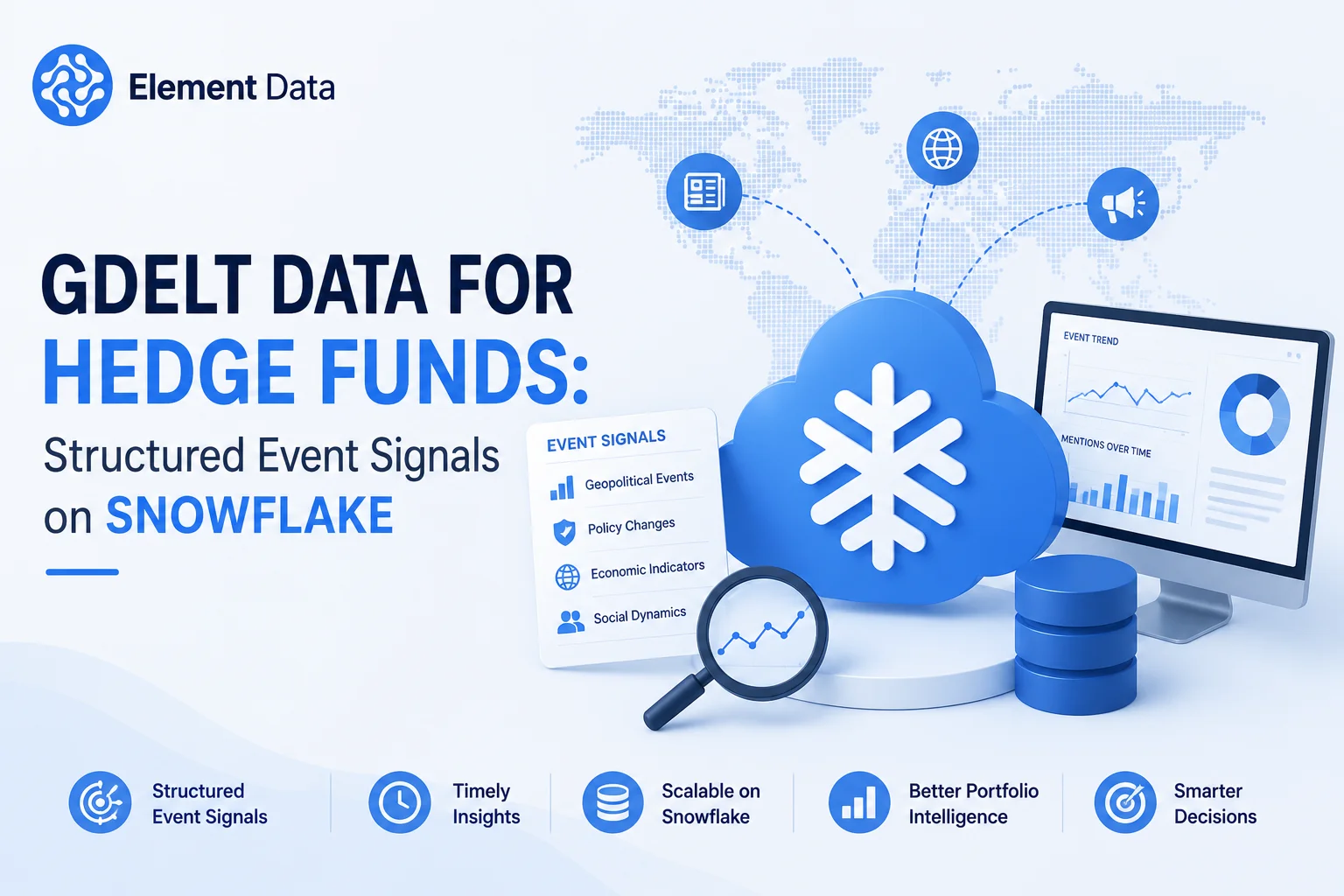
GDELT monitors news and media sources globally, extracting structured records for events, actors, locations, and sentiment.
For investment research, the relevant signals include:
- Geopolitical events: Elections, regime changes, diplomatic tensions, military activity
- Economic disruption: Labor strikes, supply chain incidents, infrastructure failures
- Regulatory and policy shifts: New legislation, enforcement actions, trade restrictions
- Public sentiment: Tone and intensity of media coverage around specific entities or regions
- Regional risk: Conflict escalation, humanitarian crises, natural disasters
Each event is tagged with geographic coordinates, actor codes, and sentiment metrics. That structure is what makes GDELT useful for systematic research rather than just news monitoring.
Read More: Clinical Trial Data Normalization: Why Raw ClinicalTrials.gov Breaks Pharma Pipelines
Where GDELT Fits in the Alternative Data Stack
Alternative data falls into two broad categories.
The first is paid panel data. Credit card transactions, geolocation signals, satellite imagery. High cost, proprietary, often exclusive.
The second is public data, normalized and delivered in a usable format. GDELT, SEC filings, Census and demographic data, macro indicators from the World Bank.
Element Data specializes in the second category. We do not sell proprietary signals. We take public datasets that are painful to ingest and normalize them so research teams can use them without the engineering overhead.
For hedge funds building an alternative data stack, that means GDELT sits alongside SEC filings and macro data as a foundational layer. Event signal, regulatory disclosure, and economic context. All queryable in Snowflake without building three separate pipelines.
Read More: AACT Clinical Trial Data on Snowflake: Why Pharma Teams Skip the Pipeline
The Edge Is Speed to Insight
The edge in alternative data is not seeing more information. Everyone has access to news. Everyone can download GDELT.
The edge is turning messy global signals into structured research inputs before consensus catches up.
That means reducing the time between event and analysis. It means building on stable infrastructure instead of fragile scrapers. It means letting research teams focus on generating insight instead of maintaining data pipelines.
Element Data exists to eliminate the normalization tax. For GDELT, that means delivering structured event data directly into Snowflake so your team can start building signals on day one.
Frequently Asked Questions
How do I access GDELT data for quantitative research without building a pipeline?
Element Data delivers GDELT as a normalized dataset directly inside Snowflake. Request access through the Snowflake Marketplace listing and query structured event data in your existing environment. No scraping, no ingestion pipeline, no schema maintenance required.
What makes GDELT useful for hedge fund signal research?
GDELT captures global events, geopolitical activity, sentiment, and tone from public media sources. For investment research teams, this creates a structured layer of real-world signals that can be joined to sectors, regions, or companies. Political instability, supply chain disruption, and regulatory pressure all become queryable research inputs.
How often is the GDELT dataset refreshed on Snowflake?
Element Data maintains regular refresh cadences for all datasets. GDELT updates follow the source availability, giving research teams consistent, current event data without manual intervention or pipeline monitoring.
Can I join GDELT event data to other datasets in Snowflake?
Yes. Because GDELT is delivered as a normalized Snowflake table, you can join it to internal data, SEC filings, Census demographics, or any other dataset in your environment. This is the advantage of Snowflake-native delivery over raw file downloads.
Is Element Data’s GDELT offering different from downloading GDELT directly?
The underlying data is the same. The difference is preparation. Raw GDELT requires parsing, normalization, and ongoing maintenance. Element Data handles that work so your team receives a queryable, stable dataset instead of raw files that need engineering before analysis can start.
Ready to add structured event data to your research stack? Request access to the GDELT dataset on the Snowflake Marketplace and start querying global event signals without building the pipeline yourself.