
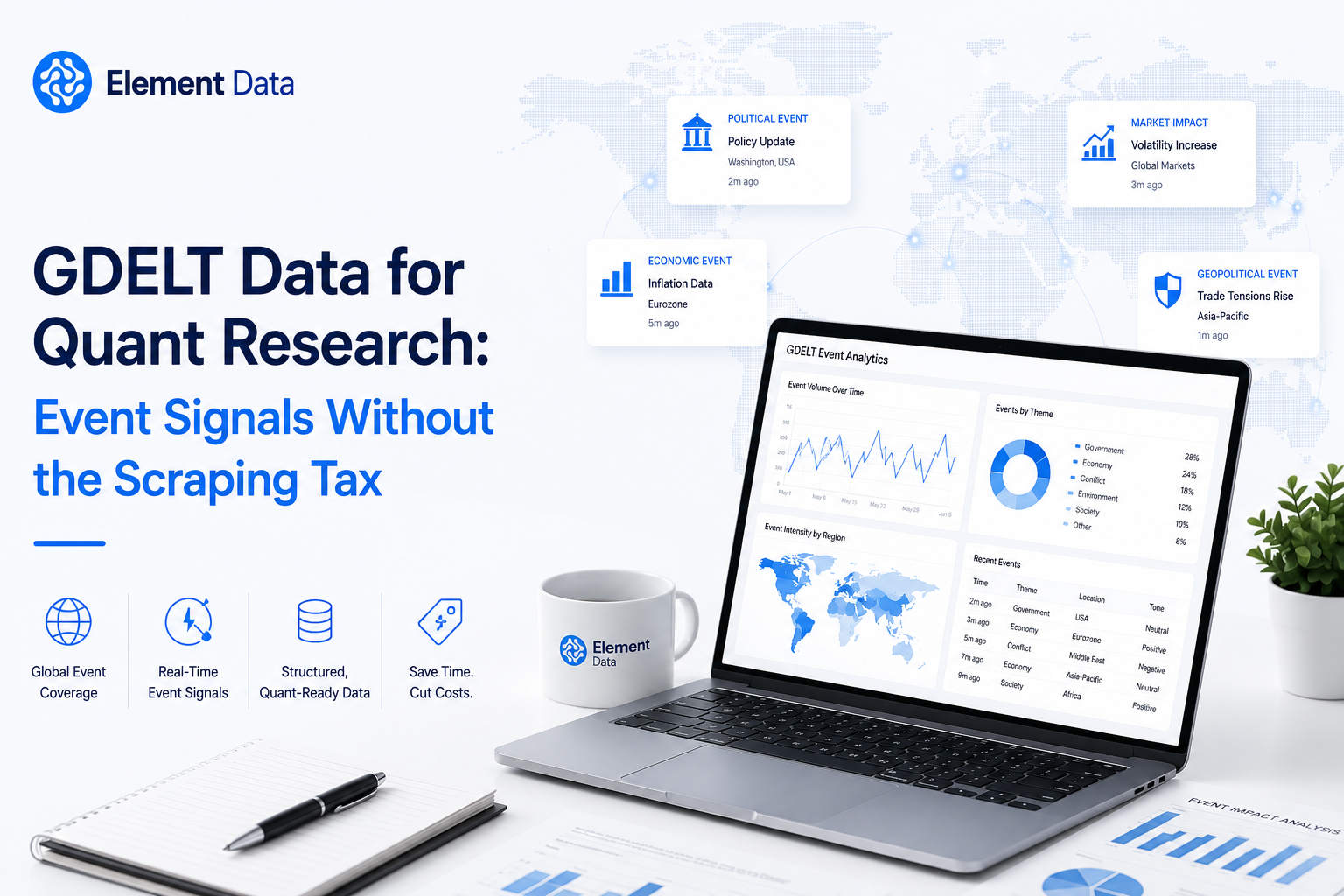
Markets move on events. Regulatory shocks, labor strikes, border disruptions, sudden shifts in media tone around a sector or region. These signals show up in global event data before they appear in quarterly filings or clean financial reporting.
For quant and investment research teams, the data exists. The problem is getting it into a usable state before the signal decays. That’s why many investment teams rely on structured alternative data delivered through Snowflake to accelerate research instead of spending weeks building ingestion pipelines.
Why GDELT Matters for Alternative Data Teams
GDELT tracks global events in near real time. It captures locations, themes, actors, language, and tone across public media sources worldwide. That makes it one of the most comprehensive open event datasets available.
The challenge is operational. Raw GDELT data is massive, fragmented, and formatted for researchers with time to spare. Hedge funds and asset managers do not have that time. They need structured data that fits into an existing research workflow without a six-week normalization project.
Most teams that try to use GDELT build their own scrapers and ingestion pipelines. Those pipelines work until they break. A format change at the source. A schema drift that silently corrupts downstream models. A backfill that takes an engineer off actual research for a week.
The normalization tax is the same problem pharma data engineers face with ClinicalTrials.gov. Different dataset, different buyer, same pattern.
Event Data as a Structured Research Input
The value of GDELT is not more headlines. It is structured event data that can survive a real research workflow.
When GDELT is normalized and available inside Snowflake, teams can test relationships against sectors, geographies, commodities, equities, and macro themes without building infrastructure from scratch.
That matters because research speed compounds. A signal that takes six weeks to prepare is usually not a signal anymore. By the time the pipeline is stable, the opportunity has moved.
Event-driven strategies need data that is ready when the hypothesis forms, not weeks later.
What Quant Teams Actually Need from Event Data
Alternative data is a broad category. Credit card panels, geolocation data, satellite imagery. Those are paid, proprietary sources with specific licensing structures.
GDELT is different. It is public data, but that does not make it easy. The difference between raw GDELT and production-ready GDELT is the difference between a research idea and a testable signal.
Quant teams evaluating event data sources care about three things:
- Refresh cadence. How current is the data? Can a model depend on it updating predictably?
- Schema stability. Will the structure stay consistent, or will a source change break the pipeline silently?
- Integration fit. Does it work inside the existing stack, or does it require a parallel infrastructure?
Snowflake-native delivery addresses all three. No scraper to maintain. No ingestion pipeline to babysit. Data arrives normalized and ready to join to internal tables.
Overview of Element Data’s alternative data offerings on Snowflake Marketplace
Combining GDELT with Macro and Demographic Context
Event data is more useful when it has context. A labor strike in one region means something different depending on the economic profile of that region. A regulatory announcement lands differently depending on the sector concentration.
Teams using GDELT for investment research often combine it with demographic and macro data sources. Census and ZCTA data add regional economic context. World Bank indicators add country-level macro signals.
When those datasets live in the same Snowflake environment, the join is trivial. When they live in separate systems with separate refresh schedules, the integration becomes its own project.
[INTERNAL LINK: Census and ZCTA demographic data available on Snowflake Marketplace]
The Build vs. Buy Math for Alt-Data Teams
A two-person alternative data team maintaining their own GDELT scraper is a team not doing research. The math is simple but often untracked.
Engineering hours spent on ingestion are hours not spent on signal development. Pipeline maintenance is a recurring cost that compounds over time. Every source change triggers unplanned work.
The total cost of self-service event data normalization often exceeds the cost of a Snowflake-native data share many times over. Most teams do not calculate it because the cost is invisible. It shows up as slower research cycles, not a line item.
How Element Data Delivers GDELT
Element Data makes GDELT available as a Snowflake-native dataset. Normalized. Refreshed. Ready to query without a pipeline to build or maintain.
For quant and investment research teams testing event-driven hypotheses, that means the data is ready when the idea forms. No waiting on a scraper fix. No backfill project before analysis can start.
The value is not access to more headlines. The value is structured event data that fits into a real research workflow on day one.
Frequently Asked Questions
How do I use GDELT for investment research?
GDELT provides structured event data including locations, themes, actors, and tone. Quant teams use it to test correlations between global events and market movements across sectors, geographies, and asset classes. When delivered Snowflake-native, it integrates directly into existing research workflows without custom ingestion.
Is GDELT considered alternative data?
Yes. GDELT is public alternative data, distinct from paid panel data like credit card or geolocation feeds. It captures global event signals from public media sources. The challenge is normalization, not access. Raw GDELT requires significant engineering to make usable for systematic research.
What is the refresh cadence for GDELT on Snowflake?
Element Data delivers GDELT with regular refreshes inside Snowflake. This allows research teams to build models that depend on current event data without maintaining their own update pipelines or monitoring for source-side changes.
Can I combine GDELT with other datasets in Snowflake?
Yes. Because GDELT is delivered Snowflake-native, it joins directly to other datasets in your environment. Teams commonly combine it with Census, ZCTA, World Bank, and SEC filings data for richer macro and regional context in their research.
How is GDELT different from news API feeds?
News APIs deliver headlines and article text. GDELT delivers structured event records with coded themes, locations, actors, and sentiment. That structure makes it usable as a quantitative research input, not just a monitoring feed.
Ready to test event-driven hypotheses without the scraping tax? Request access to GDELT on the Snowflake Marketplace and start querying structured global event data today.