
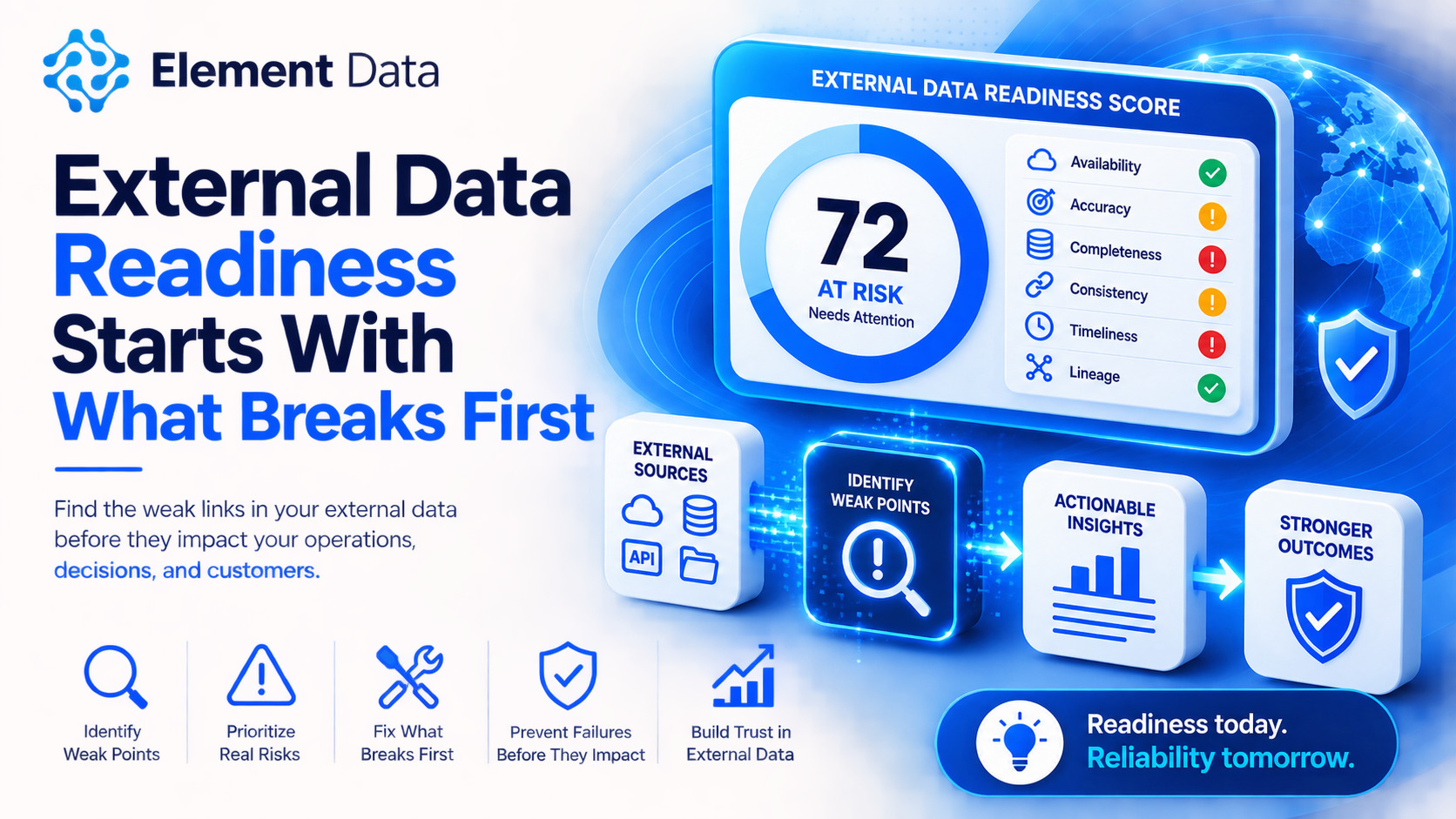
External data usually fails in the field nobody checked. That is the practical risk for healthcare and life sciences teams moving public, third-party, or semi-public data into Snowflake workflows. The dataset may look complete. The source may be familiar. The sample may query cleanly. But one stale field, weak join key, or unclear exception path can create downstream problems once the data starts supporting a real operating process.
External data readiness is not the same as data availability. Availability means the team can access the records. Readiness means the records can support the decision, refresh at the right pace, join to the right entities, and expose the records that need review before they create risk.
Start With the Decision the Data Carries
Not every column carries the same weight. A stale provider address may be acceptable for broad market sizing. The same stale address may be risky for patient routing, territory planning, or provider outreach. A missing trial status may be tolerable in an early scan. It can distort competitive intelligence if teams are tracking active studies, sponsor movement, or site activity. A weak join key may not matter during exploration. It can break repeatable reporting when the workflow depends on consistent joins every week or month.
This is why external data should be evaluated by use case, not by record count alone. The first readiness question is simple: which fields carry the decision? If a field directly affects routing, targeting, benchmarking, prioritization, enrichment, or compliance review, it needs a higher standard than a supporting descriptive field.
For Snowflake healthcare workflows, this distinction matters. Teams often bring NPPES, CMS, AACT, ClinicalTrials.gov, or other external sources into an environment where analytics, reporting, modeling, and operational logic already run. Snowflake-native access reduces ingestion friction, but it does not remove the need to understand field-level risk.
Use a Practical External Data Readiness Checklist
A useful readiness review does not need to be complicated. It needs to be specific enough to catch the failure points before the data reaches production. The core checklist should cover five areas.
First, identify which fields carry the decision. These are the fields that can change the output if they are wrong, stale, missing, duplicated, or hard to interpret. In provider data, that may include NPI, location, taxonomy, specialty, organization affiliation, or geography. In clinical trial data, it may include trial status, sponsor, condition, intervention, site, phase, or date fields.
Second, define freshness requirements. Monthly refresh may be enough for one workflow and too slow for another. A market landscape view may tolerate older records. An operating workflow that routes work, monitors active trials, or updates commercial targeting may need a different cadence.
Third, document source conflicts. External healthcare data often becomes more useful when joined with internal CRM, claims, provider, facility, trial, or territory data. When sources disagree, the workflow needs a rule for which source wins and when a record should be reviewed by a person.
Fourth, validate the joins that must work every time. Snowflake-native delivery helps teams test and use data closer to their analytics layer, but weak entity resolution or inconsistent keys can still create manual cleanup. Join readiness is often where external data moves from interesting to usable.
Fifth, define which records need human review. No external dataset is perfect. Production readiness means the workflow knows what to do with uncertain records instead of silently pushing them through the process.
Snowflake-Native Delivery Helps When the Data Is Structured for Use
Snowflake-native delivery is valuable because it reduces the operational drag around access, movement, and repeated ingestion. Teams can evaluate external sources where their analysts, engineers, and business users already work. That matters for healthcare and life sciences teams that need to compare external data with internal account, provider, payer, trial, or geography structures.
But raw access is not enough. A file in Snowflake can still require cleanup. A table can still have stale fields, unstable schemas, unclear joins, or no exception path. The useful version of external data is normalized, current, join-ready, and fit for the workflow it is meant to support.
The commercial question is not whether a dataset exists. It is whether the dataset can survive the operating process. Before a team commits external data to production, it should ask what breaks first: freshness, joins, field quality, or exception handling. That answer should shape the dataset evaluation, the scope, and the pricing conversation.
Element Data focuses on making external healthcare and life sciences data usable in Snowflake. For teams evaluating provider data, clinical trial data, CMS data, or custom external data needs, the right next step is a workflow-based fit check before committing the data to production use.